Biography of a park: (Bella Vista Park, Oakland, CA)
December 7, 2025 Sunday
So far as I know I am the only remaining member of the Friends of Bella Vista Park that was created to shepherd the park creation process. The money for the conversion (from the Bella Vista Playground: www.bellavistapark.blogspot.com) came from the Trust For Public Land. The design was developed by a group of Bella Vista neighborhood residents, primarily Jennifer Lowe (now a landscape architect in the Los Angeles Area) & Dawn Hawk (now living in Berkeley).
I never actually asked Jennifer or Dawn what the guiding principles were for the park but the design reflects certain priorities:
Use natives where appropriate
Provide a home for butterflies and other critters
Use colorful and useful plants in designated areas
Honor requests from the community
Over the past twenty-five years I have (sporadically, I admit) tried to preserve the park as a neighborhood asset. The principle threats to that status have been:
Bermuda grass (Cynodon dactylon). This warm-season grass is tenacious. In several areas of the grounds this plant choked out whatever was originally planted. I’ve finally almost eradicated it from the park (that is a small amount in the Bella Vista school garden).
Algerian Ivy (Hedera canariensis) This large-leafed ground cover chokes out all competition and provides a sanctuary for roof rats. I have tried to dig it up (primarily in the 10th Avenue strip) but there are so many roots that I’ve only been partially successful.
The irrigation system. In any public park the irrigation system will probably suffer frequent damage. The city sometimes repairs it; I try to do my part. Right now most of the system works with a few significant exceptions.
Dogs. Enough said.
Lawn weeds. Lawns in public parks generally melt away, swallowed up by grassy and broadleaf weeds. I knew that the success of the park partially depended on public use of this grassy area. I have tried to control weeds, supply fertilization, and argue with dog owners, all in defense of this important asset.
Weeds in the areas not successfully landscaped. Nothing undermines public trust in a park more than unchecked weed growth. The city has laid down mulch but that’s about all they can contribute. The rest is up to us.
Trash. I pick it up. So do others.
I was asked to list the kinds of things that I do to maintain the park. I decided to divide the park into ten areas roughly corresponding to valves within the irrigation system. For each area I tried to detail:
What was in the original design (I have the original plans made by the architect, Keller-Mitchell & Co.)
What were the original plants
What plants have been added and when
What is the status of the irrigation system
What improvements could be made
#1: East side of the park, a sloping ground cover area that had a few Manzanita that died soon after installation. There wasn’t much here. Three Crepe Myrtle trees survive from the start. There was a huge Monterey Pine that was old even when the park was first installed. It lasted a decade or so then died. The stump is still there.
A few years ago the city had a tree program. They installed two native oaks here (and two Pin Oaks in the lawn). They are doing well. In one community planting project we put in an Echium (big purple flowers) that has thrived.
Sprinkler valve #1. Over the years I’ve done some sprinkler repair here. Currently it is working 100%.
Weed control is the big issue here. The city recently mulched the entire area but the cover was porous enough that weeds have had no problem persisting.
I plan to seed this area with Bay Area native wildflowers. If successful, that should add a lot of color to this side of the park.
#2: Southeast corner inside the fence, behind the bathrooms.
Originally a bunch of manzanitas and three smoke trees. Most died rather early in the life of the park. One smoke tree and one manzanita survived until this summer when the city chopped them down as part of a project to cut down the Algerian Ivy that was smothering everything. Nothing there now.
Irrigation valve #2. Some heads work, most do not, but there’s nothing to water presently.
I will seed this with the Bay Area native plants.
#3: The narrow strip outside the fence on 11th Avenue.
Originally this was planted to ornamental grasses, a foolish choice IMHO because no one in the city had the skill or motivation to distinguish between ornamental grasses and invasive weeds. Eventually all the planted specimens died due to neglect, sprinkler problems and weed wacking by city workers. Since then I have tried simply to keep the weeds under control. There are several Cork Oaks and Tristania trees that provide shade.
Sprinkler valve #5 along the sidewalk still works but two other lines broke decades ago and were never repaired.
The extreme west end has been a dumping ground for mattresses and other garbage. Periodically I move this garbage inside the park and the city hauls it away.
This area cries out for new plants but that would take concerted effort.
#4: the lawns
Originally planted to tall fescue, a drought-tolerant lawn grass. Much of it persists to this day mixed with broadleaf weeds and grassy weeds. Over the years the city’s treatment of this area has changed as new park directors come and go; some scheduled the grass to be mowed, some considered this not worth their time (since on their books this is still a playground not a real park). When the city doesn’t mow, I do. Lately they’ve been doing it.
There were seven ornamental pear trees when the park was installed. These trees are prone to a disease called Fireblight which weakens them. More importantly the frequent watering that was done for the grass was too much for the trees. Six died from a disease called root rot (Phytophthera). In their place we put two Pin Oaks. This week I put in a native alder tree (Alnus rhomobofolia)
Sprinkler valves 3, 9, and 10. Both the city and I have periodically repaired these. Presently they all work.
#5: Southwest corner/ pollinator garden/ lemon tree/ community garden
Lots of species were put here, some of which survive. Two butterfly bushes provide food for monarch butterflies; ane tree mallow is sickly but still hanging in there. A Washington Thorn tree, a smoke tree, a coyote bush and one lemon tree all remain from the first days. Many plants died (Manzanitas, perstemons, Carpenterias, et.al.)
Over the years various community groups led by Dawn Hawk have tried to replant this area but foot traffic, theft, dogs and invasive grassy weeds have frustrated most of that work. One large sage, a penstemon and a few other perennials survive from those efforts.
Valves 11 & 12 cover this area. Most of it works.
I have tried to nurture the lemon tree, which is healthy so far.
I dream of fencing this area with a structure sturdy enough to protect new plantings. Without a fence there is no use wasting money and effort here.
#6: West side.
Our redwoods are doing great but everything else from the original installation died due to foot traffic and broken sprinklers.
Several years ago a group built a skateboarding structure here that remains.
None of the irrigation here works. But there is nothing to water.
If the skateboarding structure went away, and the sprinklers were repaired, we could plant something here but I suspect foot traffic would thwart such efforts.
#7: Maple trees along the fence, north side.
There were some shrubs here but they were choked out by bermuda grass. Two of three of the original maple trees survive.
Irrigation valve 17.
I concentrate on controlling weeds.
Mary is beginning to plant some new plants here.
#8: 10th Avenue strip west of the entrance.
The only thing put here intentionally were the five red oaks and some California lilacs (Ceanothus)
Decades ago a group of neighbors across the street from the park decided to put in succulents that they liked. These plants are still there including one huge palm tree.
There are three irrigation valves but two are broken, only #18 still functions.
Most of this area is Algerian Ivy, a thick matted weed that provides a nesting home for roof rats. I have battled this pest for 20 years. It’s not as bad as it once was but there is still lots of it here.
Several years ago we planted some more Ceanothus but the city (unaware of our efforts) mowed them down with weed wackers.
I dream of enlisting folks to dig up the remaining ivy.
#9: 10th Avenue strip east of the entrance.
Nothing was planted here mostly because the space was dominated by one towering red oak that probably dates from the building of Bella Vista School.
I removed 90% of the ivy here but some remains. One tree mallow appeared one day planted by someone. Nasturtiums planted themselves here and now fill most of the space.
The irrigation here does not work, probably broken underground.
#10: Magnolia trees along the artificial turf; pear trees along the stage area.
There actually is irrigation to some of the Magnolias but we don’t use them.
The trees are growing…….slooooowwwwwlllllllyyyyyy.
There is one blank spot near the stage where a pear tree died. It needs a new tree.
FOBVP work, summer fall 2023
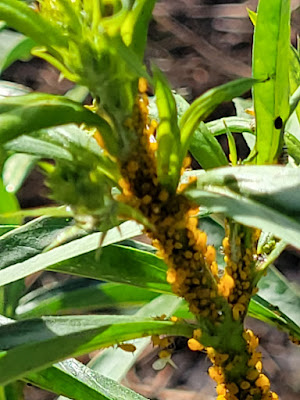
In September 2023 FOBVP planted about a dozen replacement plants in the perennial garden. Among the newbies were four milkweed plants intended as sustenance for the two monarch butterflies that live in the park. One positive development came almost immediately. The milkweeds attracted thousands of aphids. Why is this a good thing? Because aphids lure beneficial insects to the site (to feed on the aphids). I took this photo on November 3rd 2023. Thus we now have at least one happy ladybird beetle. One plant that has survived from the 2021 plantings was this sage. Butterflies love it as you can see. Our monarchs disappeared the last week in October when the flowers on our butterfly bushes faded. I trust that the monarchs will return next spring. Or maybe, if we are lucky, they will come back and plant their eggs on the milkweeds. One of the things that FOBVP has been doing is nuturing this lemon tree (a remnant from the original Keller, Mitchell design. It looks like we ...
Comments
Post a Comment